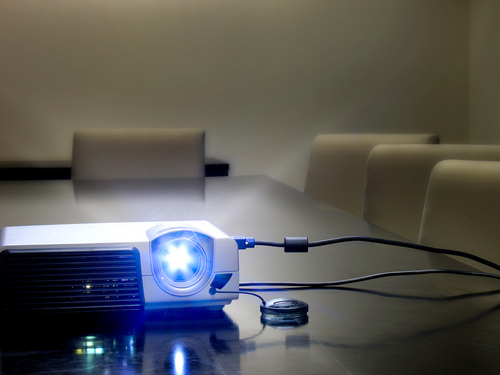
 As a follow up to our post on The Benefits of LCD Projection, we will now explore the benefits of a competing display technology: DLP (Digital Light Processing). Currently DLP is one of the leading technologies used in digital cinema projection.
 Older DLP-based projectors use metal-halide lamps combined with a color wheel. The mechanical color wheel is placed between the lamp and the DLP chip(s). The wheel is divided into multiple sections. Older models only use the three primary colors: red, green and blue, while newer projectors take advantage of the secondary colors as well: magenta, yellow, and cyan. This enables the projector to have a broader spectrum of color (This new color performance is called BrilliantColor). The chip is synched with the color wheel so that the current color of the wheel that is in front of the lamp is displayed on the DMD (digital micromirror device). The mirrors oscillate back and forth, either directing light to or away from the lens path to turn the pixel on or off. Each mirror relates to a single pixel. The wheel rotates at a high-rate (up to 10 times the frame rate) so observers can see the full color.
DLP models either offer single chip or three chip projectors. The difference is that in three chip applications, each primary color is sent to its own DLP chip, instead of all colors being sent to a single chip.
Newer DLP projectors are using high-power LEDs or even lasers for illumination, which eliminate the need for the rotating color wheel, which in-turn eliminates the "rainbow effect" (red, green, or blue 'shadows' that can sometimes be seen in high contrast or fast moving images).
DLP Projectors typically provide a larger size projection due to the fact that DLP projectors focus more on brightness and color saturation than LCD and in most cases, higher quality. Also DLP produces a great consistent picture. One of the biggest benefits of DLP is that is has a longer lifespan and its compact design.
Another benefit of DLP is that pixelation is not as visible as it is in LCD (this is known as the 'screendoor effect' in LCD projection). Also it has better black levels and contrast, which can be vital in video images.
These are some technical aspects to keep in mind when choosing the right DLP Projector Rental.
See the Full Press Release Here - DLP Projector Rentals - Is One Right For You?

 ViewSonic, a leading world provider of technology products, has decided to turn it up a notch in regards to its business development effort in the Australian market. According to recent reports, the company is seeking to accelerate its projector business in the region in order to fuel more growth.

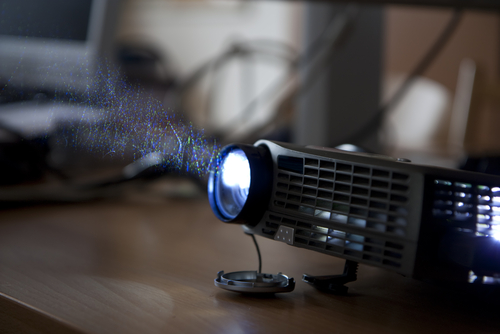 Liquid Crystal Display (LCD) Projectors display images typically by using small metal halide lamps. These lamps are used because they produce a wide range of colors at ideal color temperatures. Additionally, metal halide lamps enable a projector to emit large amounts of light (on average 2,000 to 15,000 Lumens) in a small area.
 JVC's DLA-X7 home theater projector was the recipient of the annual EISA (European Imaging and Sound Association) award. Being one of the first projectors to achieve THX 3D certification, the DLA-X7 boasts several impressive attributes. This projector offers an incredible 2D/3D experience with an astounding 70,000:1 native contrast ratio and a bright 1300 ANSI Lumens. Designed for use with 3D active shutter glasses, the DLA-X7 enables consumers to enjoy a full 3D experience while allowing for variety in choosing screen types. Additionally, this award winning projector has a powerful color management system, video processor and custom gamma control.
 Apple just recently filed a new patent which they just published that hints at the fact that projectors could one day end up in some Apple devices including things like the iPhone, iPad or as an accessory in the company's line of notebooks in order to help make it easier to share content with others.

 Projectors and PowerPoint presentations are becoming mainstays in company business meetings and school classrooms. It isn't very hard to throw a presentation together, and showing it doesn't take much work either, though most PowerPoint presentations are not too exciting. Well, Acer is hoping to make PowerPoint presentations a little more interesting with its new S5210M short-throw projector, which is said to allow you to interact with your presentations.
 Find out what is going on in the
 Taiwan-based Vivitek has just debuted a series of DLP projectors featuring direct translation from 2D to 3D with absolutely no need to transform files. 3D is becoming a bigger and bigger market in the projector industry so naturally everybody is trying to get in on the fad. However, Vivitek may be the first company to to create a projector that seamlessly transfers images from 2D to 3D.
 Sony has just recently unveiled its newest Handycam Projector. This new device will allow users to project HD video onto flat surfaces literally moments after the image or video has been shot or captured.
 Canon has just recently announced a new portable multimedia LCD projector aimed at education, traveling sales and small business markets. Known as the Cannon LV-8320, this device has a very high brightness of 3,000 lumens as well as a 2,000:1 contrast ratio. The LV-8320 also has a native wide-screen WXGA resolution of 1,200 x 800 and can accept full 1080p HD content via integrated HDMI port.
 A Tech Travel Agent can get a
  Boxlight has just recently announced the release of the company's latest product in the Seattle Series line of projectors. The new product is known as the Seattle X40N and is the brightest in the series at 4,000 lumens. The Seattle X40N also includes a robust input panel as well as many special features that make it simple and easy to use.
 BenQ, one of the leaders in projector production, has recently started shipping two new HD DLP "cinema" projectors which BenQ says are perfect for "high-rise dwellers". It is still unclear as to why the new W1100 and W1200 are perfect for multi-dwelling media rooms, however, they both feature full HD 108p resolutions, a 12-lens optical system and built-in dual 10-watt speakers that have SRS Wow HD sound technology.
 Mitsubishi Digital Electronics America introduced a new extreme short-throw line of DLP-based front projectors earlier this week. Mitsubishi's WD380U-EST and XD380U-EST projectors are both said to use high-quality, extreme short-throw lenses as opposed to mirrors in order to cast large images from short distances.
 If you own a projector, whether it be for your classroom, business or entertainment room, then you probably know that the lamps for such projectors rely on some sophisticated technology. The projectors we have at our disposal today can do things we wouldn't even have dreamed of 10 years ago. Thankfully, taking care of projectors and their associated lamps and such is not nearly as complicated as you would imagine.